55 Lakh Returnees: How the Gulf ‘Reverse Migration’ is Rewriting India’s Real Estate Playbook
SPECIAL REPORT: THE REVERSE MIGRATION REVOLUTION : 55 Lakh Returnees
BANGALORE – In what is being described as one of the most significant demographic shifts of the decade, the return of an estimated 55 lakh Indian nationals from the Gulf region is triggering a seismic transformation in the Indian property market. Driven by escalating regional tensions in West Asia and a strategic shift in global capital, this “reverse migration” is rapidly turning into a multi-billion dollar windfall for Indian developers.
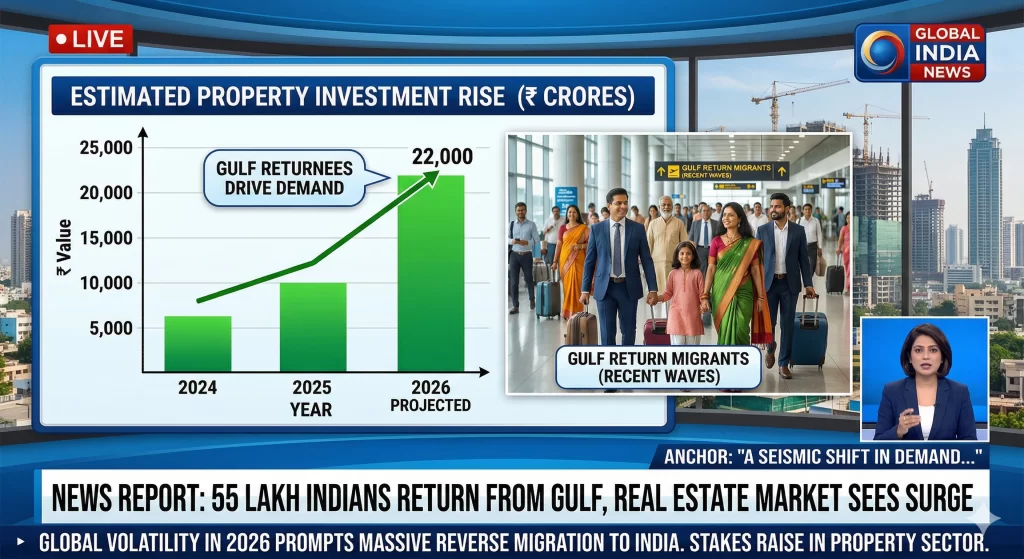
The Exodus and the “Safe Haven” Surge
As of late March 2026, the Ministry of External Affairs (MEA) confirmed that over 55 Lakh Returnees Indians returned in a single week during the height of the Iran-Israel-US tensions. This group represents the vanguard of a larger wave of skilled professionals and business owners who are liquidating assets in once-invincible markets like Dubai—where transaction volumes have reportedly dipped by 37% YoY—to reinvest in the stability of the Indian soil.
“We aren’t just seeing a return of people; we are seeing a return of high-velocity capital. The Gulf diaspora is no longer looking at India as a ‘backup’ but as their primary wealth-building engine.” — Industry Analyst, Propheadlines.
Key Market Drivers in 2026
The Currency Play: With the Indian Rupee (INR) hovering at ₹90 against the USD, the purchasing power of Gulf-earned Dirhams and Riyals has hit an all-time high. For many returnees, a luxury 3BHK in Bengaluru or Gurugram now costs 20% less in foreign currency terms than it did 24 months ago.
The “Township” Obsession: Having lived in integrated communities in cities like Dubai and Doha, returnees are shunning standalone apartments. There is a 45% surge in demand for gated townships and plotted developments in Tier-II cities like Mysore and Kochi, which offer global amenities with local roots.
Fractional Investment Boom: Not all returnees are buying villas. Younger professionals are opting for fractional ownership platforms, allowing them to diversify their savings into high-yield commercial assets with entry points as low as ₹5 Lakh to ₹10 Lakh.
The Scale of the Shift
While historical data often cites various figures for returnees, recent geopolitical volatility in the Middle East (specifically the 2026 tensions involving Iran and Israel) has accelerated this trend. Industry experts suggest that over 220,000 skilled professionals and business owners have returned in the last year alone, contributing to a broader pool of millions who are now looking to anchor their savings in Indian soil.
Why the Stakes are Rising
| Factor | Impact of Gulf Returnees |
| Demand Volume | Significant surge in premium and mid-segment housing. |
| Preferred Assets | Plotted developments, luxury condos, and fractional ownership. |
| Risk Profile | Low (Driven by end-users and long-term savings). |
| Geographic Focus | Bengaluru, Mysore, Gurugram, and coastal Kerala. |
The influx is creating a “perfect storm” for developers and investors in 2026:
Currency Arbitrage: With the Rupee hovering near the ₹90 mark against the USD (and similar strengths against Gulf currencies), returnees are finding Indian luxury properties significantly cheaper in real terms compared to a decade ago.
Capital Flight from Dubai: Traditionally, the Gulf diaspora invested heavily in Dubai. However, with Dubai’s property transactions dropping by nearly 37% YoY due to regional instability, that capital is flowing back to safe-haven hubs like Bengaluru, Gurugram, and Mumbai.
NRI Market Share: NRI investment is projected to account for 22–25% of total real estate sales by the end of 2026, up from just 10% a few years ago.
Strategic Impact on the Industry
For a journalist and consultant like yourself, these shifts offer several key angles to track:
- The Rise of “Reverse Migration” Hubs
Returnees aren’t just looking at metros. There is a surge in demand for high-end “plotted developments” and “townships” in Tier-II cities like Mysore, Kochi, and Ahmedabad. Projects with global design influences—like the Arabian or European themes seen in new townships—are particularly appealing to those who have lived abroad.
- Shift to End-User Demand
Unlike the speculative bubbles of the past, this wave is driven by end-users. These are families looking for primary residences or retirement homes, which leads to more stable, long-term price appreciation rather than volatile flips.
- Luxury and Mid-Income Boom
The “ticket size” for these investors often starts at the ₹50 Lakh to ₹1.5 Crore range for mid-income apartments, but the luxury segment in cities like Gurugram is seeing 85% YoY growth as HNIs from the Gulf seek “safe-haven” assets.
| Segment | Trend Projection | Primary Driver |
| Luxury Housing | ↑ 18-20% Growth | High Net-worth Individuals (HNIs) seeking “Safe Haven” assets. |
| Plotted Developments | ↑ 25% Surge | Preference for independent living and long-term land appreciation. |
| Construction Costs | ⚠️ 15% Increase | Rising crude oil prices due to war impacting steel and cement logistics. |
The Bottom Line
Despite the challenges of rising construction costs and global inflation, the Indian real estate industry is standing at a historic crossroads. The “55 Lakh” figure isn’t just a statistic; it represents a new class of end-user buyers who are bringing global standards, professional transparency requirements, and massive liquidity back to the domestic market.
For developers, the mandate is clear: Build for global tastes, or be left behind in the local rush.
Join our Whats app Channel : https://whatsapp.com/channel/0029Va4QnQXKQuJDKzWgtp1F
Like our Facebook page https://www.facebook.com/propheadlines/
For Latest Real Estate Investment News Log on to https://propheadlines.com/
Our Project Posting page https://propheadlines.net/