Beyond Celebration: The Financial Ethics and Social Wisdom of Eid al-Fitr by Mufti Yahya Moin
As the blessed month of Ramadan departs with its treasures of mercy, forgiveness, and spiritual renewal, it gives way to the joyous morning of Eid al-Fitr. This day is not merely a festival. It is a profound expression of Allah’s grace, His boundless mercy, and His special rewards upon His servants.
The Qur’an teaches that believers should rejoice in the فضل (grace) and رحمة (mercy) of Allah. Eid al-Fitr is a living reflection of that joy. After a month of fasting, prayer, Qur’an recitation, and spiritual discipline, Eid becomes a day of gratitude. It marks the completion of devotion. The Prophet ﷺ spoke of two moments of joy for the believer: one at the time of breaking the fast, and the other upon meeting his Lord. In this sense, Eid al-Fitr is a grand, collective breaking of the fast after an entire month of عبادت.
Islam does not leave this joy unstructured. It provides a balanced and purposeful framework. The day begins with Takbeer, echoing “Allahu Akbar,” reminding us that even our happiness revolves around the greatness of Allah. The Eid prayer then gathers the community, symbolizing unity, gratitude, and collective submission.
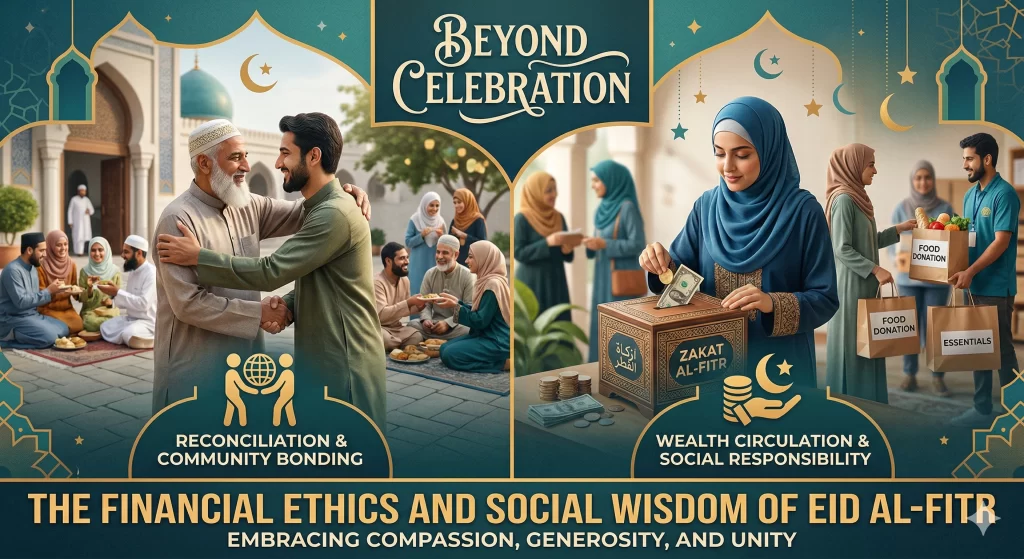
But one of the most powerful dimensions of Eid al-Fitr is its emphasis on social equality and brotherhood. Islam ensures that the joy of Eid is not confined to the wealthy. Every individual is meant to partake in it. This is why Sadaqat al-Fitr (obligatory charity before Eid) has been prescribed, along with encouragement for voluntary charity.
This charity is not a mere formality. It is part of a dignified social system. It must be given before the Eid prayer, and ideally arranged in advance. The real spirit lies in identifying genuine recipients, especially those who maintain dignity and do not ask for help. Delivering assistance quietly before Chand Raat allows them to celebrate Eid with peace and honor.
Simply giving to professional beggars does not fulfill the deeper objective. A more meaningful approach is for each household to identify a few deserving families in their locality and support them discreetly. This preserves dignity and strengthens the impact of charity.
At the same time, certain financial mistakes are commonly observed during Eid. Some treat Sadaqat al-Fitr as a burden and discharge it hastily without due care. Others delay it unnecessarily. Both approaches miss the essence.
Another major issue is excessive spending driven by social pressure and display. Many people go beyond their means, even taking loans to celebrate Eid. This is neither wise nor aligned with Shariah.
Here’s the reality. Today’s environment is deeply influenced by comparison. People often make financial decisions based on what others are doing. Recognizing this tendency is the first step toward reform.
Islam does not promote hardship, but it firmly emphasizes moderation. Even if one has financial capacity, unnecessary and excessive spending is classified as Israf (wasteful excess), which is disliked and impermissible. Spending on sinful or inappropriate activities falls under Tabdhir, which is clearly prohibited.
Wealth does not grant permission to fulfill every desire. In fact, the real test of wealth is restraint. Buying expensive clothing for a single day, preparing food in quantities that lead to waste, or hosting events purely for show are all forms of excess, regardless of financial capacity.
A practical rule is simple. Eid happiness should remain within income, not exceed it. If one is relying on credit cards, EMIs, or “Buy Now, Pay Later” schemes, it is a clear sign that spending has crossed reasonable limits.
Consider this. A household earning ₹30,000 per month spends ₹50,000 for Eid using credit or borrowing. The result is that a few days of happiness turn into months of financial stress. This is not real joy. It is delayed hardship.
Any happiness built on debt eventually becomes a burden. Similarly, spending for show, social validation, or competition destroys the true spirit of Eid.
This concern is especially relevant for the youth. Social media has turned celebrations into a display arena. Clothes, gifts, and events are showcased for validation. But not everything that shines is happiness, and not everything seen online reflects reality. The key question is: are we celebrating for ourselves, or performing for others?
Recent trends show increasing reliance on credit cards and BNPL systems among young people, especially during festivals. While these offer short-term convenience, they create long-term financial pressure.
Financial imbalance takes two forms. One is overspending through debt. The other is excessive spending despite having wealth. Both lead away from moderation and require correction.
Those blessed with wealth carry greater responsibility. If they indulge in excessive personal spending while people around them struggle for basic needs, it creates social imbalance and reflects ingratitude.
True gratitude is not reckless consumption. It is using wealth in the right way and in the right measure. Wastefulness is not appreciation of نعمت, it is disregard. Balanced spending is true شکر.
From a deeper perspective, Zakat and Sadaqat, especially Sadaqat al-Fitr, carry profound spiritual, social, and even economic wisdom. On one side, we see households spending thousands on non-essential items. On the other, there are families struggling to meet basic needs.
This is where the real message of Eid emerges.
Spiritually, Sadaqat al-Fitr purifies the fasting person from shortcomings during Ramadan. It also ensures that the poor can celebrate Eid with dignity. From an economic standpoint, it facilitates wealth circulation. Modern economics recognizes that when wealth is concentrated in a few hands, it leads to inequality, frustration, and social instability. Sadaqat al-Fitr redistributes wealth before Eid, improving economic flow and social balance.
In simple terms, it is a structured system to ensure that financial support reaches the weaker sections before Eid, enabling them to meet essential needs.
Psychologically, it reduces feelings of deprivation among the poor and fosters inclusion. For the giver, it nurtures empathy, generosity, and gratitude. At a societal level, it strengthens social cohesion and reduces the gap between rich and poor.
Eidi (gifting) is another beautiful tradition of Eid. When done with sincerity, it is rewarding. However, it should never become an obligation or a calculated exchange. In some places, it turns into a transactional system of “who gave how much.” This strips the gift of its spirit and turns it into an informal liability.
Gifts given under pressure lose their value, and accepting such gifts is also problematic. What should be a joyful expression becomes an unspoken financial burden.
Eid is also a time for strengthening relationships. Visiting relatives, supporting them, reconciling differences, and taking the first step toward mending ties are all part of its spirit. True صلہ رحمی is to reconnect even with those who may have distanced themselves.
At the same time, celebrations must remain within the boundaries of Shariah. Unnecessary mixing, immodesty, and wasteful activities like fireworks not only contradict Islamic guidance but can also be harmful.
Eid is not just a personal celebration. It is a day of unity for the Ummah. At a time when many Muslims across the world are facing hardship, oppression, and conflict, it is not appropriate to remain confined to our own joy. The true spirit of Eid calls for remembering them, supporting them where possible, and at the very least including them in our sincere duas.
We must also express gratitude for the peace and safety we enjoy and pray for its continuation.
In essence, the financial teachings of Islam around Eid—especially Sadaqat al-Fitr, voluntary charity, and balanced spending on family—must be fulfilled with care and understanding. At the same time, correcting harmful financial behaviors and excesses within society is equally important.
If Eid is celebrated with gratitude, moderation, brotherhood, and equality, it will not only bring happiness into our personal lives but also help build a compassionate, balanced, and resilient society.
About the Author: Mufti Yahya Moin
Shariah Business Consultant | Behavioral Finance Advisor
Mufti Yahya Moin is a distinguished expert at the intersection of Islamic jurisprudence and modern financial psychology. Dedicated to bridging the gap between traditional Shariah principles and contemporary economic demands, he specializes in helping businesses and individuals navigate the complexities of ethical wealth creation.
With a dual focus as a Shariah Business Consultant and a Behavioural Finance Advisor, Mufti Yahya provides a unique, holistic approach to financial management—ensuring that portfolios are not only legally compliant under Islamic law but also psychologically resilient against market volatility and human bias.
Core Areas of Expertise
Halal Business Structuring: Expertise in auditing and designing business models that adhere to Islamic principles, focusing on the elimination of Riba (usury), Gharar (uncertainty), and Maysir (gambling). He assists startups and established corporations in drafting Shariah-compliant contracts, partnership agreements (Musharakah/Mudarabah), and operational frameworks.
Behavioural Finance Integration: Moving beyond technical analysis, he applies behavioral insights to financial decision-making. By identifying cognitive biases and emotional triggers, he helps clients maintain discipline in their investment journeys, aligning their financial actions with their long-term ethical values.
Ethical Wealth Management: Providing strategic guidance on building “Pure Wealth.” This includes purifying income, calculating Zakat on complex business assets, and identifying investment opportunities in ESG (Environmental, Social, and Governance) and Halal-certified sectors.
Professional Philosophy
Mufti Yahya operates on the principle that finance is a means, not an end. His mission is to empower the global Muslim community and ethical investors to achieve financial prosperity without compromising their conscience. He believes that a truly “Halal” structure must be backed by “Tayyib” (wholesome) intentions and sound psychological habits.
Key Value Propositions
Compliance Assurance: Peace of mind through rigorous Shariah vetting of revenue streams and investment vehicles.
Strategic Advisory: Custom-tailored business roadmaps that prioritize sustainability and social responsibility.
Mindset Coaching: Specialized advisory to help investors overcome greed, fear, and herd mentality through the lens of Islamic ethics and behavioral science.
LinkedIn profile : linkedin.com/in/mufti-yahya-moin-840862209
Website : topmate.io
Email : yahya0moin@gmail.com