Transitioning from Investor to Developer
The Architect of an Empire: A Tale of Two Paths
The coffee was cold, but the conversation was electric.
Across from you sat a man who had spent thirty years building an industrial empire from steel and sweat. He had ₹20 Crore in liquid capital—a “war chest,” he called it. His plan was simple, safe, and, in your eyes, far too small for his stature. He wanted to buy a floor in a tech park or perhaps a cluster of luxury apartments. He wanted to be a landlord.
You leaned forward, setting aside the brochures of other people’s projects.
“You’ve spent your life building systems that produce products,” you said. “Why, at the height of your career, would you settle for being a line item in someone else’s ledger?”
The Fork in the Road
I painted a picture of two different futures for his ₹20 Crore.
The First Path: The Golden Cage
In this version, he signs the check. He becomes a “Premium Investor.” Every quarter, he checks his bank account for a rental credit. He deals with maintenance calls, property taxes, and the whims of the market. After ten years, his money has grown, but his name is nowhere to be found. He is a spectator in the very industry that is reshaping the skyline of South India.
The Second Path: The Foundation of a Legacy
“Instead of buying the unit,” you proposed, “build the landmark.”
You watched the industrialist’s eyes sharpen. This was a language he understood. You explained that by becoming the Developer, he wasn’t just investing money; he was deploying his industrial DNA—his discipline, his scale, and his vision.
The Transformation
You shared how that same ₹20 Crore could be the “seed” for something massive:
The Land: Not just a plot, but a canvas. Perhaps 10 acres of managed farmland or a boutique residential enclave in a high-growth corridor like Mysore or North Bangalore.
The Engine: By hiring the right architects and project managers, he turns a raw asset into a branded lifestyle.
The Multiplier: While the passive investor earns a 10% yield, the developer captures the Value Creation. He buys wholesale and sells retail. He creates the “Developer Alpha.”
The “Aha” Moment
The risk was the elephant in the room. He knew about labor, permits, and timelines—he was an industrialist, after all. But you reminded him: “The risks of a developer are the same as the risks of a factory owner. You’ve already mastered the hard part. Real estate is just a different assembly line.”
The realization hit him. Investing in someone else’s venture would give his children an inheritance. Becoming a developer would give them an institution.
The Legacy: Transitioning from Investor to Developer
As the meeting ended, the industrialist didn’t look at his watch; he looked at the horizon. He wasn’t thinking about rental yields anymore. He was thinking about the signage that would eventually bear his family name atop a gated community or a commercial hub.
He walked in as a man with money looking for a place to hide it. He walked out as a Visionary, ready to build the very world others would one day pay to live in.
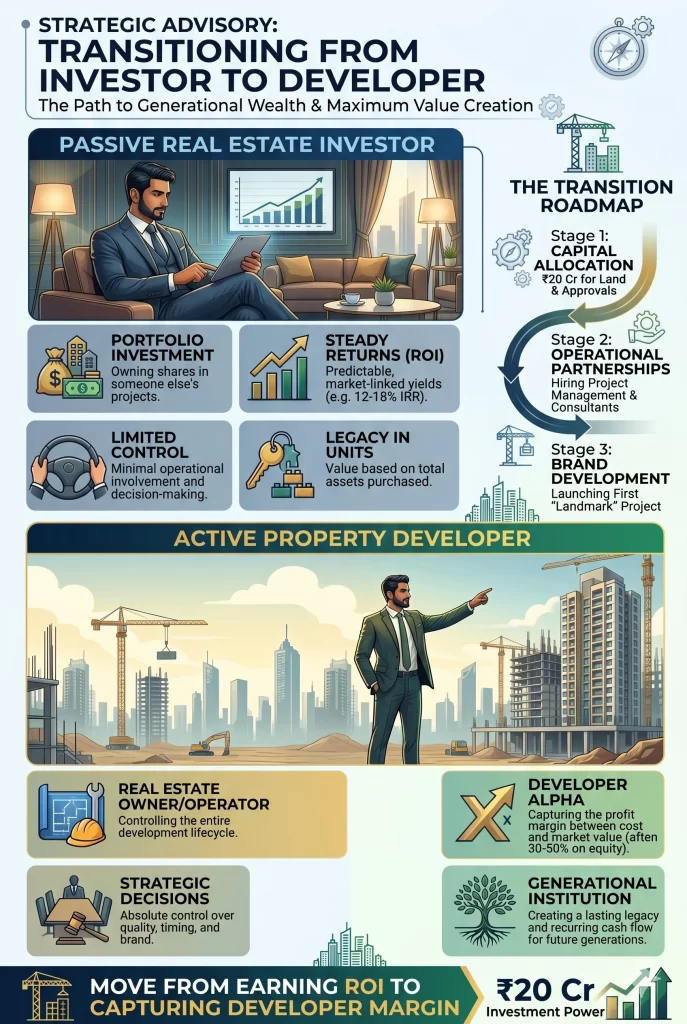
Strategic Advisory: Transitioning from Investor to Developer
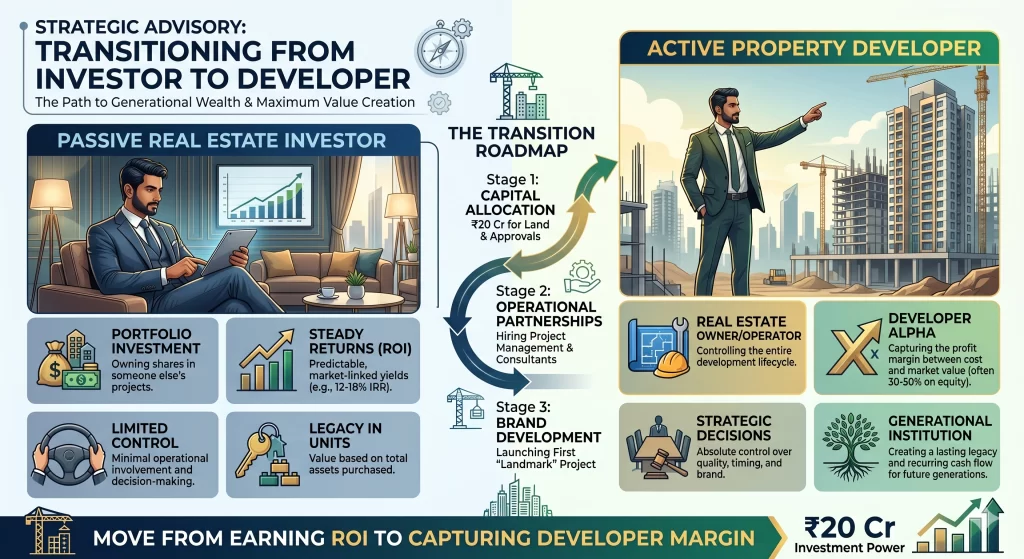
- The Core Thesis: Investor vs. Developer
In a standard investment, your capital is fuel for someone else’s engine. As a developer, you own the engine.
| Feature | Passive Investor (₹20 Cr) | Active Developer (₹20 Cr Capital) |
| Control | Minimal; dependent on the developer’s execution. | Absolute; you control quality, timing, and brand. |
| Returns | Market-linked (typically 12–18% IRR). | Multiplier effect (often 30–50% on equity). |
| Asset Value | Value of the units purchased. | Value of the brand, the land bank, and the cash flow. |
| Legacy | Financial portfolio. | Generational institution and “Landmark” creation. |
- The Power of Leverage (Capital Efficiency)
With ₹20 Crore, a passive investor buys ₹20 Crore worth of inventory. However, a developer uses that capital as Seed Equity to control a much larger Asset Under Management (AUM).
Land Acquisition: Use ₹10–12 Cr for land deposit or outright purchase in high-growth corridors (e.g., North Bangalore or Mysore Road).
Approvals & Pre-development: Use ₹3–5 Cr for conversion, sanctions, and architectural fees.
Working Capital: The remaining ₹3–5 Cr kicks off construction, which is then fueled by customer advances and construction finance.
Result: Your ₹20 Cr can effectively manage a project with a Gross Development Value (GDV) of ₹60–80 Cr.
- Building Generational Wealth
Generational wealth is rarely built on interest rates; it is built on Compounding Assets and Brand Equity.
The Multiplier: A developer doesn’t just get paid for the money they put in; they get paid for the value they create. This is “sweat equity” turned into “real equity.”
Recurring Revenue: By retaining a portion of the developed commercial space or managed farmland, the industrialist creates a perpetual cash flow machine for future generations.
The “Developer Premium”: Once the first project is successful, the “Brand” reduces the cost of capital for all future projects.
- Risk Mitigation Strategy
Moving into development does introduce risk, but for an industrialist, these are “managed risks” similar to factory operations.
Regulatory Risk: Mitigated by hiring top-tier legal and liaison consultants to handle RERA and local sanctions.
Execution Risk: Mitigated by partnering with a Project Management Consultancy (PMC) rather than trying to manage labor directly.
Market Risk: Focused on “Dual-Purpose” assets—plots or managed farmlands—which have lower construction overhead and faster exit cycles than high-rise apartments.
- The Proposed Roadmap
Phase 1: Identification (Months 1-3): Secure a 5–10 acre land parcel in an emerging hub.
Phase 2: Product Fit (Months 3-6): Design a project that caters to the “Reverse Migration” or “Managed Wellness” trend—assets that people want to own, not just invest in.
Phase 3: Launch (Months 6-12): Utilize the industrialist’s existing reputation to build trust. In real estate, Trust is the ultimate currency.
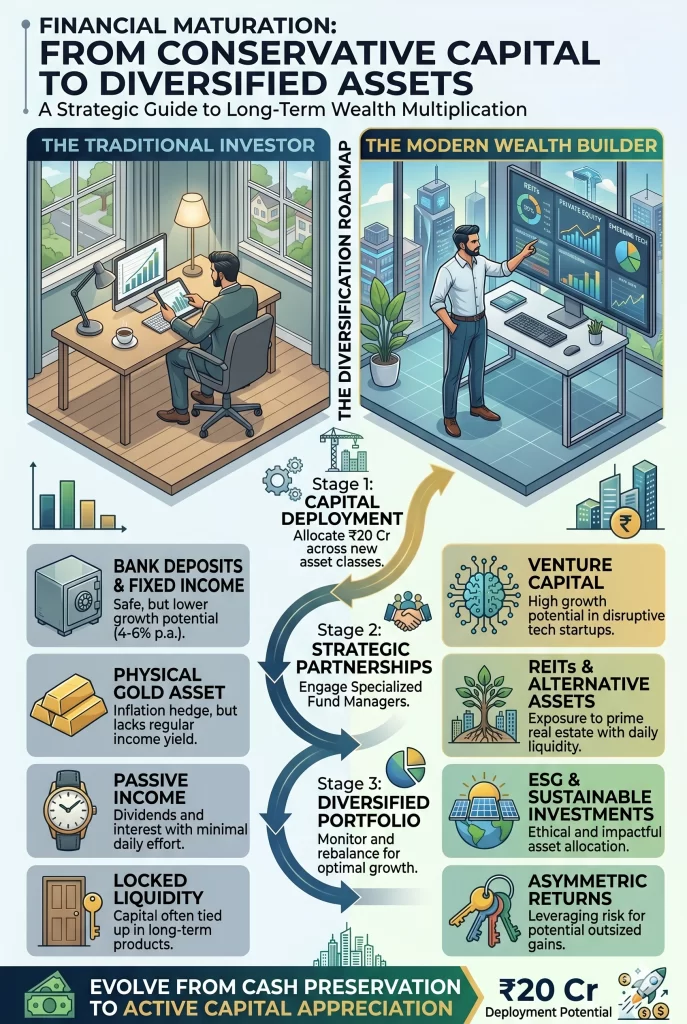
Conclusion : Transitioning from Investor
Investing ₹20 Crore makes your client a “preferred customer” of a developer. Becoming a developer makes your client the owner of the ecosystem. For an industrialist used to managing complex systems, the transition is natural, the risks are calculable, and the rewards are foundational for his family’s future.
"An investor waits for the future; a developer creates it."Join our Whats app Channel : https://whatsapp.com/channel/0029Va4QnQXKQuJDKzWgtp1F
Like our Facebook page https://www.facebook.com/propheadlines/
For Latest Real Estate Investment News Log on to https://propheadlines.com/
Our Project Posting page https://propheadlines.net/