Why BBMP & Railways Are Blocking Bengaluru Rebuilds ?
In this Article
Railway Blocks, BBMP Locks: Crores Trapped in Bengaluru’s Property Gridlock
The 50-Year Trap: Why Bengaluru Homeowners Can No Longer Rebuild Their Ancestral Homes
Red Tape & Railway Lines: How Bureaucratic Deadlocks Are Paralyzing Bengaluru Real Estate
Demolished Dreams: Raju’s Story Highlights Bengaluru’s Brutal Building Permit Crisis
Homeless on Their Own Land: The Bureaucratic Nightmare Threatening Crores in Bengaluru
From Ancestral Pride to Legal Purgatory: The Real Estate Crisis Stalling Bengaluru
Property Gridlock in Bengaluru: Crores at Stake as Railway NOC Deadlocks and Rajakaluve Buffer Disputes Throttle Redevelopment
Introduction: The Urban Real Estate Paralysis
Bengaluru, India’s Silicon Valley and one of the fastest-growing metropolises in the world, is facing a silent, unprecedented real estate crisis. Thousands of property owners across the city find themselves trapped in an impenetrable bureaucratic gridlock where crores of rupees in land and property value are effectively frozen.
At the heart of this turmoil is a crippling policy clash between the Bruhat Bengaluru Mahanagara Palike (BBMP), the urban local body, and Indian Railways, alongside fiercely contested regulations governing stormwater drains, locally known as Rajakaluves.
For generations, owning land in Bengaluru was considered a safe, generational store of wealth. Today, legacy property owners and independent residential holders are discovering that their ancestral lands have been rendered commercially and legally sterile. The collision between stringent infrastructural safety mandates, inter-departmental apathy, and rigid municipal bylaws has turned routine property redevelopment into a legal nightmare.
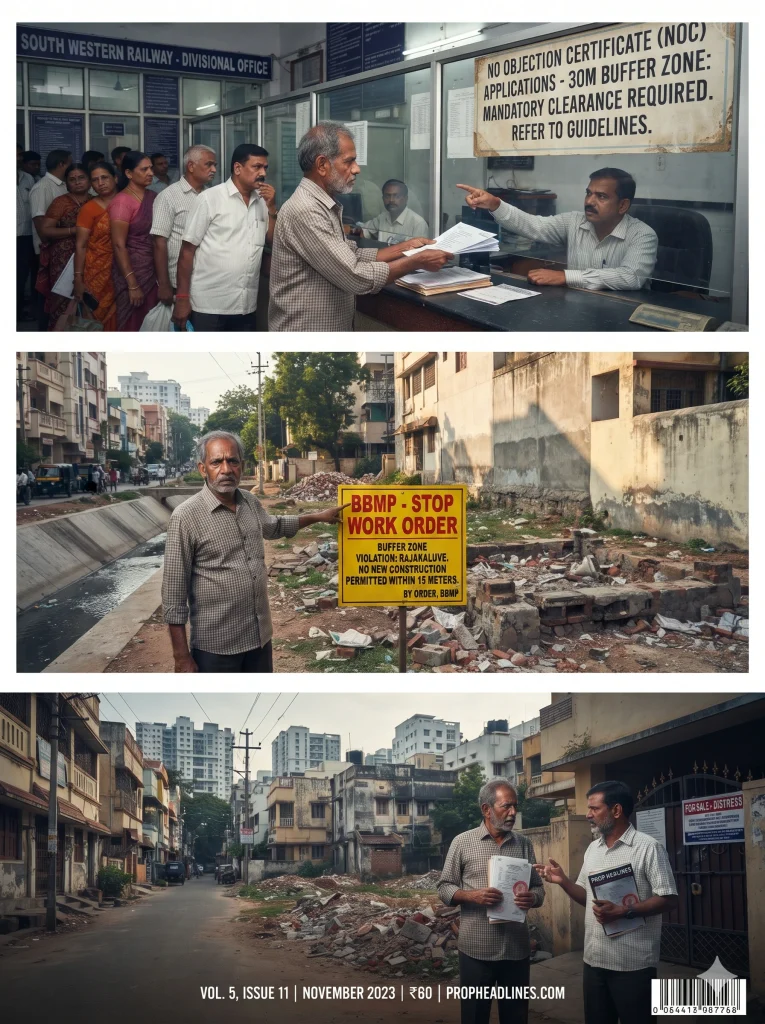
The Core Conflict: The Railway NOC Mandate and Institutional DeadlockThe primary catalyst for this systemic paralysis is a rigid administrative mandate enforced by the BBMP and urban planning authorities: any property situated within a 30-metre radius of railway land or active railway tracks must secure a No Objection Certificate (NOC) from Indian Railways before any building plan or structural reconstruction can be sanctioned. While the rule stems from railway safety guidelines and instructions issued by the Railway Board to prevent encroachments and ensure structural safety near vital transit corridors, its local execution has broken down entirely.
The Catch-22 of Railway Clearances
The Jurisdictional Wall: When property owners approach the Bengaluru Division of the South Western Railway for an NOC, they are met with administrative hesitation, endless delays, or outright refusals.
Shifting Boundaries: The 30-metre buffer is measured strictly from the legal boundary of railway land—not from the tracks themselves. Because historical railway boundaries are often disputed, ill-defined, or poorly demarcated on legacy revenue maps, railway authorities routinely refuse to issue clearances to avoid legal liability or future land acquisition complications.
The Municipal Impasse: Under current civic bylaws, the BBMP refuses to process or approve any building sanction plan without this elusive railway NOC in hand.
Consequently, property owners are trapped in a bureaucratic loop: the civic body will not clear plans without railway approval, and the railway department refuses to grant the clearance, leaving valuable urban land permanently underdeveloped.
The Rajakaluve Buffer Zone Quagmire
Compounding the railway NOC crisis is the labyrinthine set of regulations surrounding Bengaluru’s stormwater drain network, or Rajakaluves. Following recent legal frameworks and revised notifications regarding buffer zones—such as the 15-metre buffer for primary drains, 10-metre for secondary drains, and 5-metre for tertiary drains—property owners near natural drainage channels face continuous uncertainty.
Even minor overlaps or legacy discrepancies regarding drain buffers can halt a project. Coupled with ongoing litigation in the Karnataka High Court regarding buffer dimensions, the BBMP maintains an hyper-conservative stance, outright rejecting building permissions for properties that historically coexisted peacefully with secondary and tertiary drains for decades.
Case Study: Raju’s Dilemma in RT Nagar
To understand the human cost of this administrative gridlock, one needs to look no further than Raju, a lifelong resident of RT Nagar, one of Bengaluru’s established residential layouts.
Fifty years ago, Raju’s grandfather constructed a modest, sturdy family home in RT Nagar, pouring his life savings into a property meant to shelter generations to come.
Over five decades, the neighborhood evolved, transforming from quiet residential suburbs into a bustling urban node. By modern standards, however, the old structure became structurally fatigued—experiencing damp walls, aging electrical conduits, outdated plumbing, and foundations unequipped for contemporary safety codes.
The Demolition and the Rejection
Hoping to modernize the ancestral asset, Raju and his family made the emotional and financial decision to demolish the crumbling 50-year-old structure. They envisioned a modest, multi-storied independent building where Raju’s children and aging mother could live comfortably under one roof.
Armed with updated architectural blueprints, structural stability certificates, and clear title deeds, Raju applied to the BBMP for a formal building sanction plan for reconstruction. To his utter shock, the application was rejected outright.
The municipal evaluation flagged two major hurdles:
Proximity Complications: While Raju’s plot is well-established and legally registered, localized re-surveying parameters and historical zoning maps placed sections of the surrounding ward under intense scrutiny regarding legacy drain alignments and historical transit clearances.
The Bureaucratic Wall: Because municipal rules now demand stringent clearances that mimic greenfield project requirements rather than brownfield redevelopment, Raju’s application stalled indefinitely.
Raju is now left with an empty plot of land, paying property taxes on a vacant site, burdened by construction costs that escalate by the month, and legally barred from laying a single brick to rebuild his ancestral home. His life savings are locked into a plot that the system has effectively rendered untouchable.
Broader Economic Impact: Crores at Stake
Raju’s plight is not an isolated incident. Across Bengaluru—from older residential belts like Malleshwaram, Seshadripuram, and RT Nagar to rapidly densifying extensions near railway corridors—crores of rupees worth of private real estate are paralyzed.
Erosion of Asset Value: Independent landowners cannot monetize, redevelop, or upgrade their properties. Old, dilapidated buildings continue to stand, posing safety hazards because owners fear that demolishing them will permanently strip them of their building rights.
Banking and Financial Stagnation: Financial institutions and housing finance companies are increasingly reluctant to disburse home loans or reconstruction loans for properties lacking clean, modern BBMP sanction plans or caught in railway/drain buffer crossfire.
The Shadow Market: Such paralysis breeds informality. Frustrated owners often face intense pressure to bypass official channels, opening the door for unauthorized constructions, unapproved vertical extensions, and systemic corruption.
Conclusion and the Path Forward
The standoff between the BBMP, Indian Railways, and property owners highlights a severe disconnect between macro-level infrastructure safeguarding and micro-level urban governance. While protecting public infrastructure, railway safety zones, and stormwater drains is paramount for sustainable city planning, it cannot come at the total expense of citizen property rights and urban renewal.
For legacy owners like Raju, and for thousands across Bengaluru watching their generational wealth turn into legal quicksand, urgent administrative intervention is required. A single-window clearance mechanism, joint demarcation surveys by revenue, railway, and municipal authorities, and pragmatic amnesty frameworks for brownfield redevelopments are the need of the hour. Until then, Bengaluru’s real estate landscape remains heavily chained by red tape, leaving timeless family legacies stranded in a modern bureaucratic maze.