Invest – Build – Transfer Concept by Prop Headlines
We are offering the Following Properties
10000 sqft of Land off Hennur Main Road
Total land Selling at Rs 6000 / sqft – 6 Crore
50% Fractional Investment offered at Rs 3 Crore
25% Fractional Investment offered at Rs 1.5 Crore
12.5% Fractional Investment offered at Rs 75 Lakhs
Safe and secured Investment – The Land will be Directly Registered in your name
We will Invest the Funds required for Construction of the Apartments as we enter into Joint development pattern arrangement with all the investors syndicate
Real Estate Investments with Absolute Clarity
Ph : 9845017139 / 9845044734
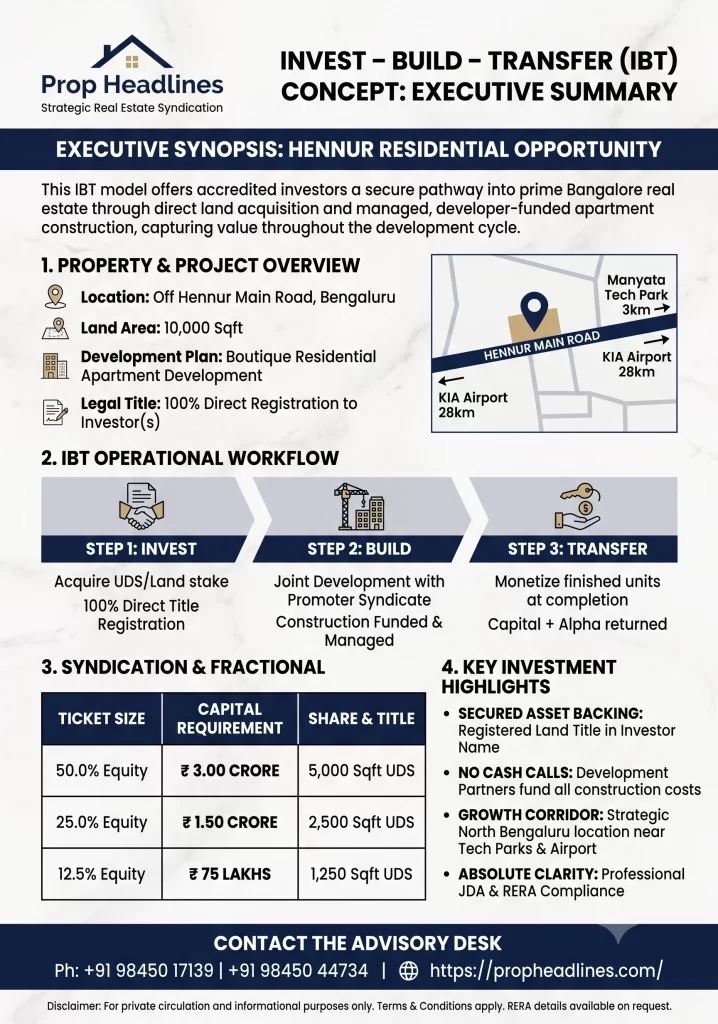
Invest – Build – Transfer (IBT) Model
Structured Real Estate Syndication | Prop Headlines
Transform land investment into high-yield residential equity. Through our Invest – Build – Transfer framework, you acquire direct, registered land ownership in Bengaluru’s high-growth Hennur corridor, while our development syndicate funds and executes construction under a structured Joint Development Agreement (JDA).
- Project & Land Snapshot Location: Prime parcel off Hennur Main Road, Bengaluru Total Land Extent: 10,000 sq.ft. Land Value: ₹6,000 / sq.ft. Total Land Consideration: ₹6.00 Crore Asset Class: Prime Residential Plotted Land slated for Apartment Development Legal Security: 100% direct registration of undivided land share (UDS) / land parcel in the investor’s name
- Fractional Syndication Structure
Investors can participate across multiple ticket sizes suited to high-net-worth portfolios:
| Shareholding Tier | Equity Stake | Capital Commitment | Title & Security |
| Strategic Tier | 50.0% | ₹3.00 Crore | Direct Land Registration (1:1 backing) |
| Partner Tier | 25.0% | ₹1.50 Crore | Direct Land Registration (1:1 backing) |
| Syndicate Tier | 12.5% | ₹75 Lakhs | Direct Land Registration (1:1 backing) |
- How the “Invest – Build – Transfer” Model Operates
1.Invest: Direct Land Acquisition:
Clear, unencumbered asset backing.
Investors pool into a syndication structure. The land parcel is directly registered in the investor’s name in proportion to their equity contribution, ensuring an immediate physical asset hedge with clear title ownership.
2.Build: Joint Development Arrangement:
Zero investor construction liability.
The investor syndicate enters into a formal Joint Development Agreement (JDA). Prop Headlines / development partners infuse the requisite construction funds, secure sanction plans, and manage development execution end-to-end without developer-call debt on the investors.
3.Transfer: Sales Monetization & Exit:
High capital multiplier on completion.
Finished residential apartment units are marketed and sold to end-buyers at finished-market rates (yielding substantial upside over raw land cost). Capital and accrued profits are systematically transferred back to syndicate partners.
- Key Investor Highlights
Tangible Collateral: Unlike typical financial instruments or unbacked real estate notes, your capital is locked directly into legal land registration.
Capital Appreciation + Development Arbitrage: You enter at raw land cost (₹6,000/sq.ft.) and exit at finished residential apartment rates, capturing both micro-market land appreciation and development margin upside.
No Construction Hassle: The development syndicate undertakes municipal approvals, architectural planning, vendor management, and structural construction.
Strategic Growth Corridor: Hennur Main Road / North Bengaluru continues to benefit from rapid transit expansion, tech park proximity (Manyata Tech Park / KIADB Aerospace Park), and seamless airport connectivity.
Redefining Real Estate Wealth: Inside Prop Headlines’ “Invest – Build – Transfer” (IBT) Model
For decades, real estate investment across India—and specifically within Bengaluru’s dynamic micro-markets—has operated under two standard extremes. On one end is the conservative buyer who acquires land, fences it, and waits patiently for capital appreciation over decades while contending with maintenance, boundary surveillance, and property tax compliance. On the other end is the retail homebuyer or speculative investor purchasing finished apartments at retail prices, absorbing peak construction costs and developer profit margins from day one.
Between land ownership and end-unit sales lies the most lucrative phase of property economics: the development margin. Historically, this value-creation stage was the exclusive preserve of large-scale developers, well-capitalized family offices, and institutional private equity funds.
Prop Headlines is bridging this structural gap with a proprietary investment framework: the Invest – Build – Transfer (IBT) syndication model. Designed for high-net-worth individuals, seasoned professionals, and strategic capital allocators, the IBT framework democratizes development arbitrage while maintaining institutional-grade legal security.
What Is the Invest – Build – Transfer (IBT) Model?
The Invest – Build – Transfer architecture is an asset-backed property syndication model structured on a Joint Development pattern. It strips away the traditional operational headaches of real estate development while granting private investors direct ownership and maximum value creation.
- Invest (Asset Backing & Direct Registration)
Unlike debt debentures, unbacked fractional promissory notes, or opaque investment pools, IBT is rooted in registered property title. Investors participate in prime, pre-vetted land parcels. Crucially, the land is registered directly in the name of the investor or investor syndicate in proportion to their equity contribution. There are no custodial loopholes or derivative pledges; the investor holds the core asset directly on record with the sub-registrar.
- Build (Funded Development Execution)
Raw land yields passive appreciation, but developed residential real estate yields operational alpha. Under the IBT model, the syndicate enters into a structured Joint Development Agreement (JDA). Prop Headlines and its development partners mobilize the construction capital, secure plan sanctions, coordinate architectural and structural designs, and manage contractor execution end-to-end. The land investor carries zero day-to-day project management obligations and zero builder debt exposure.
- Transfer (Monetization & Profit Distribution)
Upon completion (or phased pre-sales during execution), the resultant residential units are marketed and sold to end-users at prevailing market rates. Because the investor acquired the underlying land basis at raw land rates (₹6,000/sq.ft.) rather than finished apartment super-built-up pricing, the monetization phase captures both land appreciation and development margins. Capital and profits are systematically transferred back to the investor syndicate upon unit disposals.
Featured Opportunity: 10,000 Sq.Ft. Off Hennur Main Road, Bengaluru
To launch this structured initiative, Prop Headlines has unlocked a prime land acquisition opportunity in North Bengaluru’s premier growth belt.
| Parameter | Details |
| Location | Prime residential parcel off Hennur Main Road, Bengaluru |
| Total Land Parcel | 10,000 sq.ft. |
| Land Rate | ₹6,000 per sq.ft. |
| Total Land Valuation | ₹6.00 Crore |
| Development Proposed | Boutique Mid-to-High-End Residential Apartments |
| Legal Security | Immediate, direct title deed registration to investor |
| Execution Pattern | Joint Development Agreement (JDA) with builder equity |
Fractional Syndication Tiers
To allow flexible portfolio allocation, this 10,000 sq.ft. Hennur holding is structured across three fractional equity tiers:
| Tier | Equity Stake | Capital Requirement | Title Backing |
| Strategic Tier | 50.0% | ₹3.00 Crore | Direct registered title share (5,000 sq.ft. basis) |
| Partner Tier | 25.0% | ₹1.50 Crore | Direct registered title share (2,500 sq.ft. basis) |
| Syndicate Tier | 12.5% | ₹75 Lakhs | Direct registered title share (1,250 sq.ft. basis) |
By structuring fractional entry points starting from ₹75 Lakhs, accredited investors can secure a registered footing in North Bengaluru’s land market without committing an entire multi-crore land parcel outlay on their own.
The Strategic Macro: Why Hennur Main Road?
Real estate syndication succeeds or fails based on micro-market fundamentals. Hennur Main Road has emerged as one of the most resilient, capital-absorptive corridors in Greater Bengaluru for several distinct reasons:
Aerospace & IT Engine Connectivity: Positioned midway between Manyata Tech Park—one of Asia’s largest operational office hubs—and the KIADB Aerospace Park (home to major international aerospace, hardware, and engineering hubs), Hennur captures an affluent, high-retention tenant and buyer profile.
Direct Kempegowda International Airport (KIA) Access: The Hennur-Bagalur link functions as an essential alternative arterial route to KIA, insulating the corridor from the acute congestion points of the primary Ballari Road corridor.
Social & Civic Infrastructure: The belt is flanked by established international schools, multi-specialty healthcare centers, retail destinations, and upcoming metro line connections along the Outer Ring Road (ORR) and airport transit corridors.
Consistent Rental & Capital Velocity: Demand for 2 BHK and 3 BHK boutique residences in this sub-market outpaces supply, creating a reliable buyer base for end-unit off-take upon project completion.
Risk Mitigation: How IBT Protects Investor Capital
Every investment carries risk; mature real estate investors judge an opportunity by its downside protection. The IBT model is intentionally engineered with safety firewalls:
IBT THREE-TIER SAFETY FIREWALL
- 100% Registered Asset Title –> No unsecured notes or corporate IOUs
- Developer Capitalized Build –> Investor holds zero personal debt burden
- Pre-agreed Exit & Transfer –> Structured timeline for liquidity
Direct Title as Sovereign Collateral: In conventional fractional real estate, capital is frequently routed via Special Purpose Vehicles (SPVs) or private debt notes where the investor’s name does not appear on the land deed. Under IBT, you own the underlying asset directly. If market conditions fluctuate, the land remains registered in your name—an inflation-hedged, unencumbered physical asset.
Elimination of Execution Overhang: Independent land buyers who attempt their own construction regularly stumble on plan sanctions, local body liaisoning, contractor fraud, and supply-chain delays. Under IBT, seasoned professionals take over construction funding and site operations under a transparent Joint Development contract.
Transparent Monetization: The project’s timeline, unit allocation ratio, and sales monetization parameters are established contractually before ground is broken, eliminating post-facto disputes over realization payouts.
The Shift Toward “Absolute Clarity”
For the modern investor, the era of unverified property tips, speculative pre-launches, and complicated multi-layered paperwork is closing. Prop Headlines was established on the principle of editorial diligence, objective market analysis, and transactional integrity.
The Invest – Build – Transfer program represents the natural evolution of that mission: presenting an institutional-grade land-development model with complete transparency, uncompromising title safety, and high value creation.
Connect with the Advisory Desk
Due diligence files, title documents, site layouts, and syndicate documentation for the Hennur Main Road parcel are available for review upon request.
Advisory Line: +91 98450 17139 | +91 98450 44734
Digital Desk: https://propheadlines.com/
Consultation: Private briefings available by prior appointment at our Bengaluru offices.
Investor Due Diligence FAQ: Invest – Build – Transfer (IBT) Model
This 10-point FAQ provides legal, structural, and tax clarity for accredited investors evaluating the Invest – Build – Transfer (IBT) syndicate model for the Hennur Main Road residential parcel.
- What exact legal title document proves my ownership in the property?
Your equity stake is secured through an absolute, registered Sale Deed executed directly at the Sub-Registrar’s office in your individual name (or entity name). You receive a proportionate Undivided Share of Land (UDS) / physical title stake (e.g., 50% = 5,000 sq.ft. equivalent; 25% = 2,500 sq.ft.; 12.5% = 1,250 sq.ft.). You do not receive an unbacked corporate debenture, promissory note, or derivative contract; your name is directly inscribed in the Encumbrance Certificate (EC) and revenue records.
- How does the title transition from raw land to the Joint Development Agreement (JDA)?
Once the land purchase is registered, the investor syndicate—acting collectively as the lawful Landowner / Co-Owners—enters into a registered Joint Development Agreement (JDA) and a concurrent General Power of Attorney (GPA) with the development partner.
The JDA grants the builder the license to enter, obtain sanctions, and execute construction.
The GPA is strictly limited to development execution and liaisoning with local planning authorities (BBMP/BDA/RERA).
Ownership of the land never transfers to the builder; only development rights are granted.
- What is the typical JDA sharing ratio, and what does the syndicate receive?
In high-growth North Bengaluru corridors such as Hennur, standard JDA sharing ratios generally operate between 55:45 and 50:50 (depending on floor area ratio, road width, and sanctioned heights).
Syndicate (Landowner Share): Typically ~50% of the total built-up residential area and corresponding car parks.
Developer Share: ~50% of the built-up area in exchange for infusing 100% of the construction cost, approval expenses, architectural fees, and site execution.
- Who pays for construction costs, municipal approvals, and contractor delays?
The development partner finances and manages the construction end-to-end. The investor syndicate bears zero cash calls for raw materials (cement, steel), labor, contractor overheads, or liaisoning fees. Project cost overruns or supply chain inflation are absorbed entirely within the developer’s margin, insulating the investor’s original capital from escalation liabilities.
- How is the project governed under Karnataka RERA (K-RERA)?
The project is registered under K-RERA before any marketing or pre-sales begin. Under RERA regulations, the investor syndicate is categorized as the Promoter (Landowner), while the builder is the Promoter (Developer). A dedicated RERA escrow account is opened where 70% of buyer receivables are locked strictly for project execution, ensuring transparent capital management and legally binding milestone completions.
- How and when is the investment monetized and transferred back?
Monetization occurs via the Transfer phase through two primary exit pathways:
Phased Pre-Sales During Construction: Units allocated to the landowner syndicate under the supplementary allocation agreement can be sold to retail home buyers once RERA approvals are active.
Bulk Monetization Upon Handover: Units are sold at finished-apartment market pricing upon structural completion / Occupancy Certificate (OC), unlocking peak retail realization.
Proceeds are distributed pro-rata to the syndicate partners’ designated bank accounts as each unit sale deed is registered.
- When does the capital gains tax liability trigger under Section 45(5A)?
For individual investors and HUFs, Indian tax law provides significant cash-flow protection under Section 45(5A) of the Income Tax Act:
Capital gains tax is deferred and is not payable when you sign the JDA. The tax point crystallizes only in the financial year in which the competent authority issues the Completion Certificate (CC / OC) for the project.
Note: If an investor transfers or assigns their share of apartments to a third party prior to the issuance of the Completion Certificate, the tax deferral under Section 45(5A) lapses for those specific units, and capital gains are computed under standard transfer provisions for that year.
- How are capital gains computed and taxed on exit?
When the Completion Certificate is issued, the Full Value of Consideration (FVC) for the landowner syndicate is deemed to be the Stamp Duty Value (Guidance Value) of their allocated built-up share on that date, plus any cash consideration received.
Cost of Acquisition: Your original land purchase price (plus registration costs) is deducted from the FVC.
Applicable Tax Rate: As per prevailing capital gains provisions, long-term capital gains (LTCG) on immovable property held beyond the statutory holding window are taxed at 12.5% (without indexation).
Eligible investors can also deploy exemptions under Sections 54 or 54EC (e.g., REC/PFC capital gain bonds) to reduce tax outgo
What are the GST implications on the landowner’s share?
Transfer of Development Rights (TDR): Under GST notifications, liability on the transfer of development rights for residential apartments is handled by the developer under the Reverse Charge Mechanism (RCM).
Sale of Finished Flats: If units allocated to the syndicate are sold to end-buyers after receiving the Completion Certificate / Occupancy Certificate (CC/OC), no GST applies (Schedule III of CGST Act).
If units are sold during the under-construction phase, standard residential GST applies (typically 5% for non-affordable housing, collected from the buyer without Input Tax Credit).
- What happens if the developer faces delays or insolvency?
The IBT structure incorporates multiple protective covenants to secure investor capital:
The Land Remains Yours: The underlying land is never pledged or mortgaged for the builder’s project finance loans. The builder has no legal authority to create third-party encumbrances on the syndicate’s land share.
Milestone Default Clauses: The JDA contains explicit forfeiture and termination clauses. If construction halts beyond the stipulated cure period, the power of attorney is revocable, and the syndicate retains the land along with whatever structural improvements have been constructed on-site.
Supervisory Authority: As registered land titleholders, the syndicate retains inspection rights and joint signatory authority on the final conveyance deeds of buyers.