Forex Trading Under the Shariah Lens: Investment Opportunity or Structured Gambling? by Mufti Yahya Moin
The Illusion of Easy Profit in the Digital Age
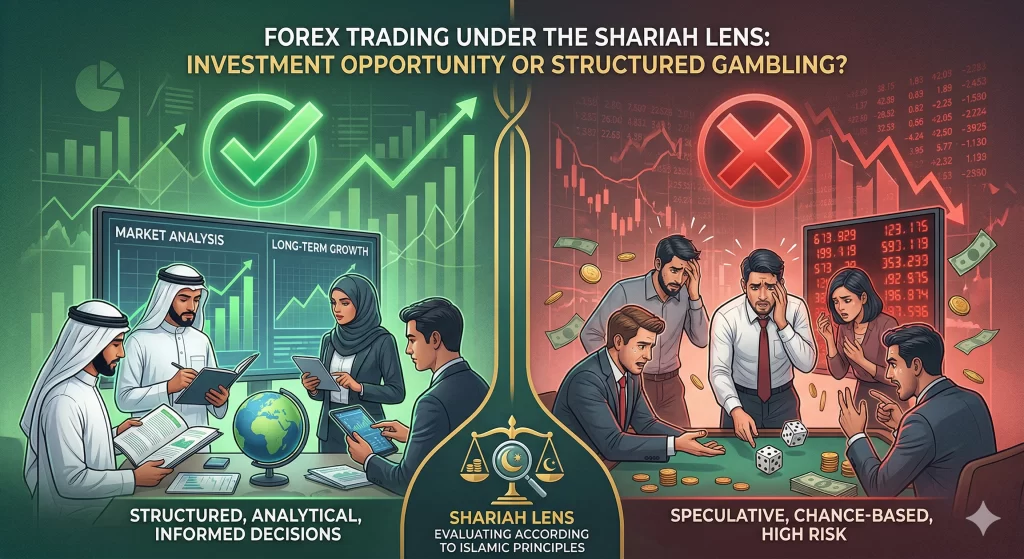
In today’s digital economy, where investment opportunities are reduced to a few taps on a screen, online forex trading has emerged as a widely promoted avenue for quick profits. It appears modern, accessible, and financially rewarding. Yet beneath this polished surface lie serious intellectual, ethical, and Shariah concerns.
As global financial markets become increasingly digitized, many financial models are gaining popularity not because they are sound, but because they appear simple and profitable. Online forex trading is one of the most prominent examples of this trend. While it is often marketed as a golden opportunity, a deeper examination reveals structural issues rooted in uncertainty, speculation, and potential deception.
Shariah Looks Beyond Appearances
Islamic law does not judge transactions by their outward form alone. It evaluates their substance, structure, and consequences.
When forex trading is examined through this lens, several fundamental flaws become clear.
A valid sale in Shariah requires:
- The actual existence and exchange of the asset
- Clear identification of the asset
- Real ownership and possession (Qabd)
In forex trading, while currencies such as dollars, pounds, or euros appear to be bought and sold, the reality is quite different. The trader does not receive actual ownership of the currency, nor can they take possession of it in a meaningful sense. No actual asset is changing hands.
Instead, the entire system revolves around price movements. Profit and loss are not tied to real trade or economic activity, but to speculation and prediction.
The Problem of Non-Existence and Over-Trading
In practice, either the currency being bought is non-existent or there is a limited number present being traded in much larger volumes i.e. the same unit of currency is traded repeatedly among multiple participants, sometimes dozens or even hundreds of times. This phenomenon, often referred to as over-trading, raises a serious concern.
From a Shariah perspective, this resembles transactions involving:
- Selling what one does not own (Bay‘ ma la yamlik)
- Selling what is not in one’s possession (Bay‘ ma laysa ‘indaka) and Selling what is non-existent.
All these are clearly prohibited in Islamic teachings.
As a result, the concept of real ownership becomes almost non-existent. What remains is merely the movement of numbers on a screen rather than the exchange of tangible value.
The Illusion of Possession
The issue becomes even clearer when one attempts to take delivery of the purchased currency.
If a trader requests actual delivery, they are not given the currency itself. Instead, they receive its cash equivalent based on the current rate. This indicates that the currency was never truly owned or transferred.
This disconnect between appearance and reality makes the entire structure invalid and closely resembles gambling (Qimar), where outcomes depend on uncertain bets rather than real economic exchange.
“Islamic Accounts”: A Change of Name, Not Reality
Some platforms attempt to address religious concerns by offering “Islamic accounts.” However, changing terminology does not alter the underlying reality.
Renaming interest as a “fee” or “service charge” does not make it permissible. Similarly:
- Leverage-based structures
- Rollover fees
- Penalties for delayed settlement
remain problematic regardless of how they are labeled.
A well-established legal maxim in Islamic jurisprudence states:
“Consideration in contracts is given to meanings, not to words and forms.”
(العبرة في العقود للمعاني لا للألفاظ والمباني)
In other words, Shariah evaluates the substance, not the branding.
Forex vs Stock Market: A Necessary Distinction
A common question arises: if speculation exists in stock markets as well, why is forex treated differently?
The key distinction lies in the presence of real assets.
In the stock market:
- Investors hold shares in actual companies
- These companies have assets, operations, real business activities and economic output
- Profits and losses are linked to real business performance
While speculation does exist, it is anchored to genuine economic activity.
In forex trading, however:
- There is no underlying asset
- No real ownership
- No productive activity
The transaction is purely based on price fluctuation, making it fundamentally different.
A Zero-Sum System
Forex trading operates as a zero-sum system. One party’s gain is directly another’s loss.
Islamic economic principles do not support such structures. Wealth generation in Islam is meant to be:
- Value-creating
- Cooperative
- Ethically grounded
When profit comes purely at the expense of others, without any real value creation, it contradicts the spirit of justice and fairness in Islamic economics.
Psychological and Ethical Consequences
One of the most concerning aspects of forex trading is its psychological impact.
It conditions individuals to:
- Chase quick profits
- Act impulsively
- Develop dependence on uncertain outcomes
Initially, it creates the illusion of being a sophisticated investor. Over time, however, many become trapped in a cycle of greed and recovery-driven decision-making, similar to gambling behavior.
Small gains fuel confidence. Losses trigger riskier decisions. This pattern mirrors the psychology of gambling, which Islam explicitly warns against due to its destructive effects on individuals and society.
A System That Rewards Imbalance
Forex markets often create an uneven playing field between large financial institutions and individual traders.
Retail participants typically lack:
- Information advantage
- Speed
- Capital strength
This imbalance leads to consistent losses for weaker participants, contributing to unjust wealth concentration—something that Islamic economic principles strongly oppose.
Conclusion: Beyond Halal and Haram Lists
Islam does not merely provide a list of permissible and impermissible actions. It aims to develop a mindset rooted in responsibility, ethics, and awareness.
In Islamic economics, profit is tied to:
- Real effort and real assets
- Risk-sharing
- Value creation
Forex trading, in its current form, largely fails to meet these standards. It neither creates real value nor promotes equitable economic participation.
Instead, it shifts wealth without productive contribution, often at the cost of the less informed and less powerful.
About the Author: Mufti Yahya Moin
Shariah Business Consultant | Behavioral Finance Advisor
Mufti Yahya Moin is a distinguished expert at the intersection of Islamic jurisprudence and modern financial psychology. Dedicated to bridging the gap between traditional Shariah principles and contemporary economic demands, he specializes in helping businesses and individuals navigate the complexities of ethical wealth creation.
With a dual focus as a Shariah Business Consultant and a Behavioural Finance Advisor, Mufti Yahya provides a unique, holistic approach to financial management—ensuring that portfolios are not only legally compliant under Islamic law but also psychologically resilient against market volatility and human bias.
Core Areas of Expertise
Halal Business Structuring: Expertise in auditing and designing business models that adhere to Islamic principles, focusing on the elimination of Riba (usury), Gharar (uncertainty), and Maysir (gambling). He assists startups and established corporations in drafting Shariah-compliant contracts, partnership agreements (Musharakah/Mudarabah), and operational frameworks.
Behavioural Finance Integration: Moving beyond technical analysis, he applies behavioral insights to financial decision-making. By identifying cognitive biases and emotional triggers, he helps clients maintain discipline in their investment journeys, aligning their financial actions with their long-term ethical values.
Ethical Wealth Management: Providing strategic guidance on building “Pure Wealth.” This includes purifying income, calculating Zakat on complex business assets, and identifying investment opportunities in ESG (Environmental, Social, and Governance) and Halal-certified sectors.
Professional Philosophy
Mufti Yahya operates on the principle that finance is a means, not an end. His mission is to empower the global Muslim community and ethical investors to achieve financial prosperity without compromising their conscience. He believes that a truly “Halal” structure must be backed by “Tayyib” (wholesome) intentions and sound psychological habits.
Key Value Propositions
Compliance Assurance: Peace of mind through rigorous Shariah vetting of revenue streams and investment vehicles.
Strategic Advisory: Custom-tailored business roadmaps that prioritize sustainability and social responsibility.
Mindset Coaching: Specialized advisory to help investors overcome greed, fear, and herd mentality through the lens of Islamic ethics and behavioral science.
LinkedIn profile : linkedin.com/in/mufti-yahya-moin-840862209
Website : topmate.io
Email : yahya0moin@gmail.com