Karnataka Government Notifies New Lake Buffer Rules 2026; Governor Grants Assent After Months of Delay
BENGALURU – In a significant move that reshapes urban development and environmental regulation across the state, the Karnataka government on Wednesday, February 18, 2026, officially notified The Karnataka Tank Conservation and Development Authority (Amendment) Act, 2025.
The new law, now registered as Karnataka Act No. 19 of 2026, marks the end of the long-standing uniform 30-metre buffer zone for all water bodies. Instead, it introduces a tiered setback system that varies based on the size of the lake or land parcel.
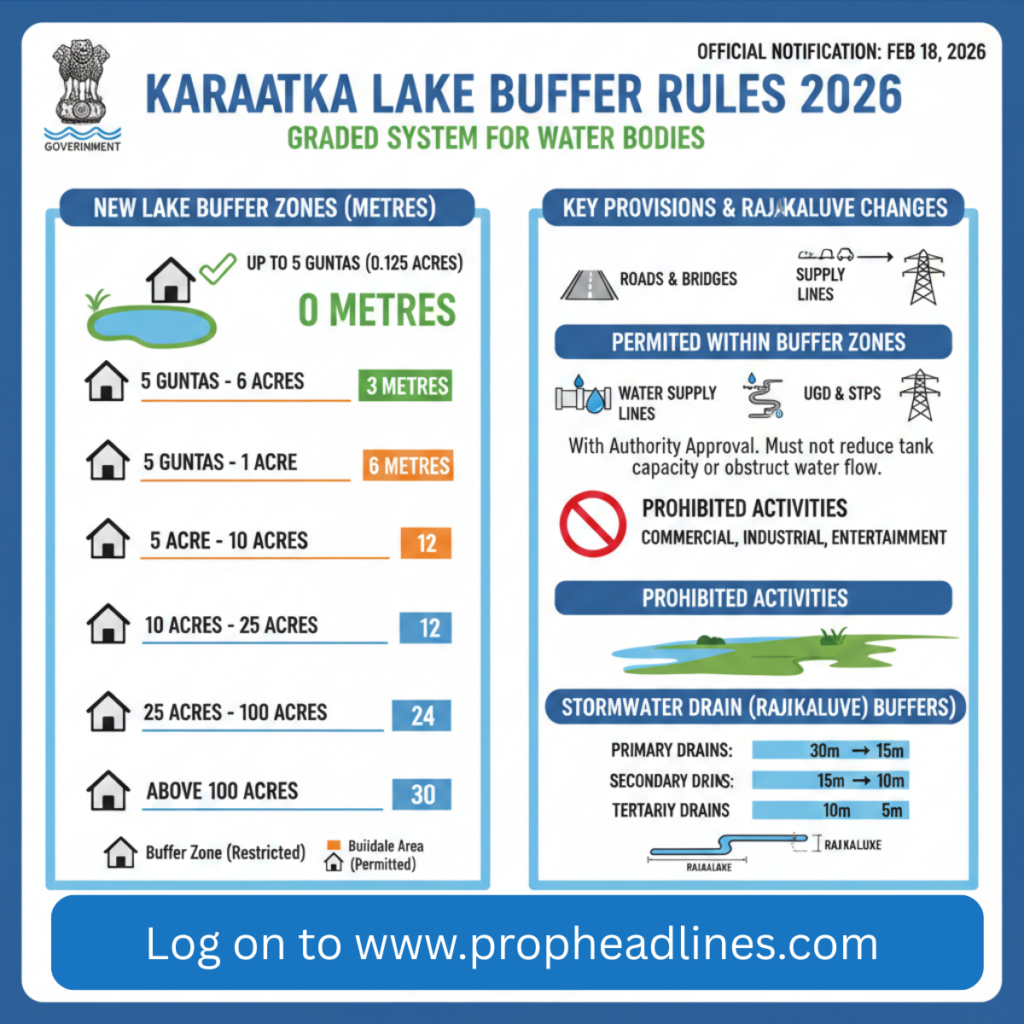
Key Provisions & Infrastructure
The new rules distinguish between private commercial development and public utility services:
Permitted Public Utilities: With prior approval from the Authority, the government can now construct roads, bridges, water supply lines, sewage treatment plants (STPs), underground drainage (UGD), and electrical lines within these buffer zones.
Prohibited Activities: Commercial, industrial, and entertainment-related activities remain strictly prohibited within the designated buffer zones.
Conditions for Work: Any public infrastructure work must ensure that the original capacity of the tank is not reduced and that the natural inflow or outflow of water is not obstructed.
Breaking the Deadlock
The notification follows a period of administrative tension. While the amendment was passed by the state legislature in August 2025, Governor Thaawarchand Gehlot had initially returned the bill, seeking clarity on potential “adverse effects” to the ecosystem. After the government provided assurances that the move was aimed at resolving “land-use deadlocks” for small property owners and would not harm major water bodies, the Governor gave his formal consent on Monday, February 16.
The New Graded Buffer Zones
Under the notified rules, the distance from the lake boundary where construction is restricted is now categorized as follows:
Focus on Public Infrastructure
A key pillar of the 2026 Act is the relaxation for essential public utilities. For the first time, the state is permitted to construct the following within buffer zones, provided the lake’s capacity and natural water flow are not compromised:
Roads and bridges
Water supply and underground drainage (UGD) lines
Sewage Treatment Plants (STPs) and pump houses
Electrical transmission lines
Reaction: Relief vs. Resistance
The real estate sector has largely welcomed the move, noting that it unlocks thousands of small plots in peri-urban areas that were previously “unbuildable” due to the strict 30-metre rule.
However, citizen groups like the Federation of Bengaluru Lakes (FBL) have expressed disappointment. Activists argue that reducing the buffer zones—which act as vital flood mitigators—will lead to further encroachment and ecological degradation. V. Ramaprasad, convenor of FBL, stated that the federation is considering challenging the notification at an “appropriate legal level,” citing concerns over a pending National Green Tribunal (NGT) case on the same matter
Join our Whats app Channel Whats App Channel : https://whatsapp.com/channel/0029Va4QnQXKQuJDKzWgtp1F
Like our Facebook page https://www.facebook.com/propheadlines/
For Latest Real Estate Investment News Log on to https://propheadlines.com/
Our Project Posting page https://propheadlines.net/