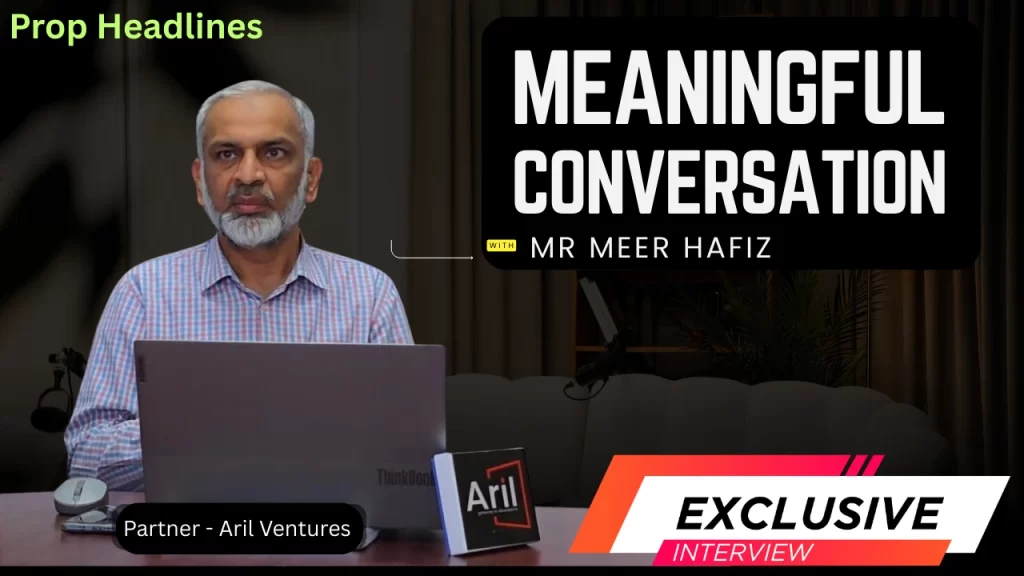
The Meaningful Conversation with Meer Abdul Hafiz, Partner Aril Ventures
Executive Summary: The Aril Ventures Interview
Guest: Mr Meer Abdul Hafiz, Director of Aril Ventures and Developers Pvt Ltd.
Focus: Specialized Construction, Cross-Sector Innovation, and Ethical Business Growth.
Overview
This interview explores the vision of Mr Meer Abdul Hafiz, a versatile entrepreneur navigating the intersection of infrastructure, healthcare, and education. As the Director of the newly incorporated Aril Ventures and Developers (est. June 2024), Hafiz is positioning the firm not just as a construction entity, but as a catalyst for “Abundance through Values.”
“From the quiet corners of R.T. Nagar to the high-stakes world of multi-sector venture capital, Meer Abdul Hafiz is a man on a mission. As the driving force behind Aril Ventures and the Nurturecave Foundation, Hafiz doesn’t just build houses—il builds ecosystems. Whether it’s creating sustainable infrastructure or empowering the next generation of professionals through Skillcave, Hafiz’s approach is a testament to the power of diverse leadership. We go behind the scenes with the Director of Aril Ventures to explore the man behind the titles.”
“In the rapidly shifting skyline of Bangalore, success is often measured in square footage. But for Meer Abdul Hafiz, the Director of Aril Ventures and Developers, the blueprint for the future is built on more than just brick and mortar. With a portfolio that spans from cutting-edge healthcare technology to grassroots skill development, Hafiz is part of a new breed of polymath entrepreneurs. We sat down with him to discuss how his latest venture, Aril, aims to redefine ‘specialized construction’ by blending ethical growth with the high-tech demands of a modern metropolis.”
“When Aril Ventures and Developers Private Limited was incorporated in mid-2024, the market asked: ‘What does specialized construction look like in a post-pandemic world?’ Director Meer Abdul Hafiz has the answer. By bridging the gap between his work in healthcare innovation (Mediniq) and tech-driven education (Skillcave), Hafiz is bringing a multi-disciplinary rigour to the construction sector. In this exclusive interview, he reveals how Aril Ventures is navigating the complexities of the Karnataka real estate market while maintaining a philosophy of ‘Abundance through Values’.”
About Aril Ventures
Aril Ventures is a Bengaluru-headquartered real-estate development company committed to building modern, sustainable and value-driven projects across Karnataka.
Founded in 2024 as a private-limited firm (CIN U43299KA2024PTC189993), Aril Ventures brings together a diverse team of professionals with decades of collective experience in construction, project management, and real estate development
Aril Ventures is a forward-thinking real estate development company dedicated to creating modern, sustainable, and value-driven properties across Karnataka.
Aril Ventures focus is on delivering premium residential layouts, farmland communities, and commercial developments that combine smart design, quality infrastructure, and long-term investment values
At Aril Ventures, our mission is to develop sustainable, high-quality real estate projects that combine innovation, integrity, and long-term value — creating communities that inspire modern living and growth
The Vision is To be a trusted leader in real estate and construction, building sustainable developments that elevate modern living and create lasting value for communities and investors
At Aril Ventures, we are driven by a deep commitment to creating high-quality, value-focused real estate developments. Our team works with integrity, precision, and a long-term vision to ensure every project delivers trust, transparency, and lasting value.
Creating Meaningful Spaces From plotted developments to joint-venture projects, we focus on smart planning, sustainable design, and strong execution. Every detail is carefully handled — from land assessment to final development — ensuring our projects are functional, future-ready, and built to enhance lifestyles.
Quality You Can Trust With experienced professionals, reliable processes, and strict quality standards, we deliver developments that offer security, long-term appreciation, and a better living experience for our customers and investors.
Key Discussion Pillars
The Aril Mandate: Beyond traditional real estate, Aril Ventures focuses on “Specialized Construction Activities,” including hospital infrastructure, high-tech installations (facades and glazing), and turnkey civil projects.
The Synergy of Innovation: Hafiz discusses how his leadership in other ventures—Mediniq Healthcare (HealthTech) and Skillcave Innovation (EdTech)—influences Aril’s approach. He advocates for “smart spaces” that prioritize user wellness and technological readiness.
Social Responsibility: A significant portion of the dialogue centers on the Nurturecave Foundation. Hafiz highlights his belief that business success is inseparable from social impact, specifically in skill development and community welfare.
Future Strategy: The “Aril Gateway to Abundance” philosophy aims to expand the company’s footprint across Karnataka by 2026, focusing on sustainable building practices and bridging the skilled labor gap through integrated training initiatives.
Core Takeaway
“Business is a vehicle for value. At Aril Ventures, we aren’t just changing the skyline; we are building the infrastructure for a more skilled, healthier, and technologically integrated society.” — Meer Abdul Hafiz
Offside: We Discussed 3 Major Issues
- Dalhousie Moment in Indian Companies
- Make in India – The Fact and Challenges / The Dominance of China in the Manufacturing Sector
- To Build the Bridge between the People Who have Skills/ Ideas and the One who have Wealth / Resources
In Indian business history, the “Dalhousie moment” was a point where a legal policy (the Doctrine of Lapse) forcibly ended dynasties that lacked natural heirs. Today, Corporate India is facing its own modern version of this—though this time, the “lapse” is voluntary.
As of 2025, India is witnessing a massive generational shift. While the previous generation built empires through “animal spirits” and grit, the new generation is increasingly choosing to walk away from the operational side of their forefathers’ businesses.
- The Disinterest Gap: By the Numbers
Recent studies from 2024 and 2025 highlight a stark reality for family-owned businesses (FOBs), which contribute approximately 79% of India’s GDP:
The Reluctance: Only 7% of Indian heirs report feeling a sense of “obligation” to join the family enterprise.
The Survival Rate: Historically, only 30% of family businesses survive the transition to the second generation, and only 15% make it to the third.
The Disconnect: While 88% of founders trust their children’s ability to lead, nearly 45% of those founders do not actually expect their children to take over.
Why the “Next-Gen” is Opting Out
The reasons for this shift are both cultural and economic:
From “Factories to Family Offices”: Heirs are moving away from asset-heavy traditional industries (like manufacturing or textiles) toward “asset-light” sectors. Instead of running a factory, they prefer managing the family’s wealth through Family Offices or Private Equity firms.
The Lure of Corporate Stability: Corporate jobs offer social security, predictable hours, and professional “meritocracy” that traditional shops or family units often lack.
Digital and Purpose-Driven Aspiration: Next-gen scions, often educated abroad, are more interested in AI-driven startups, sustainability (ESG), and social impact than in managing legacy labor disputes or supply chain logistics.
Structural Shifts in Indian Companies
To prevent a “Dalhousie-style” collapse, many Indian firms are adopting new survival strategies:
Professionalization: Large houses like Tata, Godrej, and Reliance have pioneered the “Owner-Custodian” model—where the family retains ownership and board seats but hires professional non-family CEOs to run day-to-day operations.
The “Intrapreneurship” Compromise: Some families allow heirs to start entirely new divisions or “incubators” within the existing company, giving them the freedom of a startup with the capital of a legacy firm.
Legal Uniformity: The Repealing and Amending Bill of 2025 has recently simplified succession laws (like removing mandatory probate for wills in certain cities), making it easier for families to transfer assets even if the business management is professionalized.
Make in India – The Fact and Challenges / The Dominance of China in the Manufacturing Sector
While India is now a top global mobile phone producer, much of the work remains low-value assembly. India still imports over 80% of its components (chips, displays, etc.) for high-tech goods, mostly from China is the Challenge
The Goal: The focus in 2026 should be shifting towards “Deep Manufacturing”—producing the core components domestically rather than just putting them together.
Building a bridge between Talent (Skills/Ideas) and Capital (Wealth/Resources) is the fundamental engine of economic growth
Building a bridge between Talent (human capital) and Capital (financial resources) is the mechanism that transforms potential into productivity. When these two forces align, they create a “multiplier effect” that serves as the engine for modern economic growth.
Here is a small summary of how this synergy works:
- The Catalyst for Innovation
Ideas and skills (Talent) are the “blueprints” for progress, but they remain theoretical without the “materials” (Capital). Financial resources allow talented individuals to experiment, build prototypes, and scale solutions. This bridge is most visible in Venture Capital, which specifically bets on high-potential ideas that traditional banks might find too risky.
- Boosting Productivity Talent provides the “know-how” to use technology and optimize processes. Capital provides the tools (machinery, software, infrastructure) to execute those processes. The Result: A skilled worker with modern equipment is exponentially more productive than either the worker alone or the machine without a pilot.
- Creating “Knowledge Spillovers”
When capital flows into talent-heavy hubs (like Silicon Valley or Singapore), it creates a dense environment where ideas collide. This leads to knowledge spillovers, where the success of one funded idea inspires and educates others in the same ecosystem, accelerating growth across the entire economy.
- Economic Mobility and Job Creation
Bridging this gap isn’t just about high-tech startups. When a person with a trade skill (Talent) gains access to a small business loan (Capital), they transition from a jobseeker to a job-creator. This stabilizes communities and increases the tax base, further fueling national growth.
Join our Whats app Channel Whats App Channel : https://whatsapp.com/channel/0029Va4QnQXKQuJDKzWgtp1F
Like our Facebook page https://www.facebook.com/propheadlines/
For Latest Real Estate Investment News Log on to https://propheadlines.com/
Our Project Posting page https://propheadlines.net/